By serahsiew May 15, 2022 5:11 PM
How I Organised Malaysia’s Biggest 3D Perceptual Art Installation — and Broke a National Record
By Serah Siew — Creative Director, Organising Chairman & Contemporary Artist, Kuala Lumpur, Malaysia
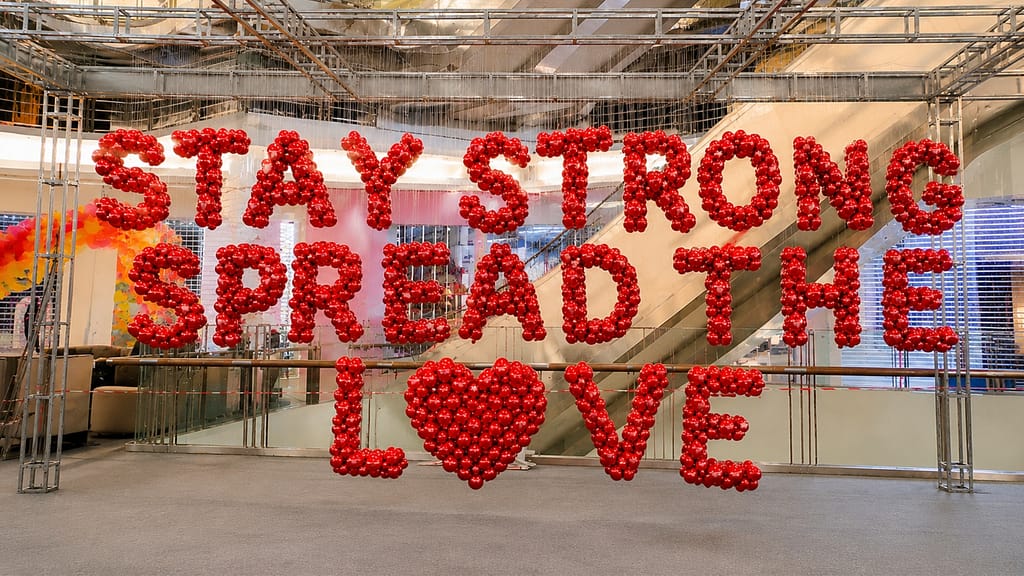
In 2021, in the middle of a pandemic, with a team of 40 people from completely different industries, zero prior experience in large-scale installation art, and a shopping mall shoplot as our studio — we built Malaysia’s biggest 3D perceptual art installation. And we broke the Malaysia Book of Records to prove it.
This is the story of Stay Strong, Spread the Love — a community-driven CSR campaign, a record-breaking 3D art installation, and one of the most challenging, most meaningful things any of us had ever been part of.
What Is 3D Perceptual Art?
Before I tell you how it happened, let me explain what we were actually building.
3D perceptual art — sometimes called 3D anamorphic art or optical illusion installation — is an art form that manipulates perspective, material placement, and spatial arrangement so that a structure appears to transform into a three-dimensional image when viewed from a precise angle. Unlike conventional sculpture, the “3D effect” does not physically exist in all directions. It lives in the relationship between the artwork and the viewer’s eye.
In Asia, 3D perceptual art has appeared most prominently in urban street murals across China, immersive digital experiences in Japan, and large-format public installations in South Korea. In Southeast Asia — and particularly in Malaysia — large-scale, record-level 3D perceptual art installations were, at the time of our project, essentially uncharted territory.
That was exactly the point.
The Beginning: A Conviction, Not a Client Brief
Stay Strong, Spread the Love was not a commissioned project. No brand called me with a budget. No agency handed me a brief. This was born from a personal conviction — and a very specific moment in time.
It was 2021. Malaysia was still living under the weight of COVID-19. Movement restrictions were in place. Businesses were struggling. Communities were isolated. And there was a group of people in our society — the OKU (Orang Kurang Upaya, or persons with disabilities) — who were among the most vulnerable, the least visible, and the most in need of support.
I had recently joined the Junior Chamber International Kuala Lumpur (JCIKL) — a leadership and community service organisation. I was new. I didn’t know most of the members. But I had an idea that would not leave me alone.
What if we raised funds for OKU through art? Not a charity dinner. Not a donation drive. Something that would stop people in their tracks, spark a conversation, create media coverage — and, if we did it right, land in the Malaysia Book of Records.
I called the committee members one by one. I told each of them the idea. And one by one, they said yes.
That was how Stay Strong, Spread the Love began.
The Team Nobody Expected
Here is what made this team extraordinary: none of them were designers.
We had 40 committee members and volunteers ranging in age from 23 to 80 years old. Industry leaders from finance, business, F&B, technology, healthcare, and beyond. People who had never set foot in an art installation, let alone built one. People who had never worked together before.
I was the Organising Chairman. I was also new to JCIKL, and I was taking on the largest project the chapter had ever attempted — as a first-timer.
There was no blueprint to follow. No template. No precedent. We were building the blueprint as we built the installation.
What held us together was not experience. It was shared belief in the idea, and in each other.
The Mall Hunt: Ten Emails, One Yes
One of the earliest and most underrated challenges was finding a venue.
Our team reached out to almost ten major shopping malls across Kuala Lumpur. We needed not just a display space, but a venue willing to host a large, complex, physically demanding installation during a period when the entire retail industry was fighting for survival under COVID restrictions.
These were cold emails. We had no existing relationship with any of these malls. No introduction, no warm contact, no guarantee that anyone would even open the message. Without a venue, the entire project could not move forward — not one step. The installation couldn’t be built in a void. The record attempt couldn’t happen without a physical space. Everything — the team, the calculation, the bottles, the fishing lines, the fundraising — all of it was contingent on a reply from a building management inbox we had no connection to.
So we waited. And waiting, in that situation, is its own kind of pressure.
Within a week, five malls responded. Five out of ten — that alone felt like a sign. They offered us display areas: show windows, corridor spaces, atrium edges, for up to a month.
But only Paradigm Mall in Petaling Jaya gave us what we actually needed: an empty shoplot. A blank, physical space large enough to build the installation from scratch, with room for our team to work, restructure, and refine the piece over weeks before it moved to the centre court.
That yes from Paradigm Mall changed everything. We are deeply grateful for their generosity and trust.
The Design: Two Views, One Impossible Calculation
The visual concept of Stay Strong, Spread the Love was not a single image. It was two.
Stand in front of the installation and you would read the words: Stay Strong, Spread the Love — bold, typographic, resolved perfectly in three dimensions from the front viewing point.
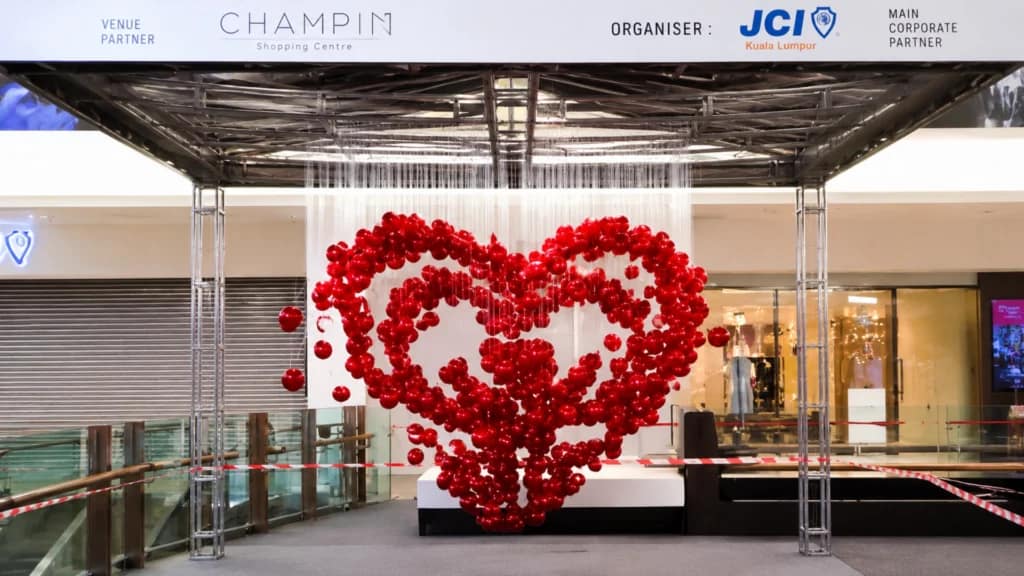
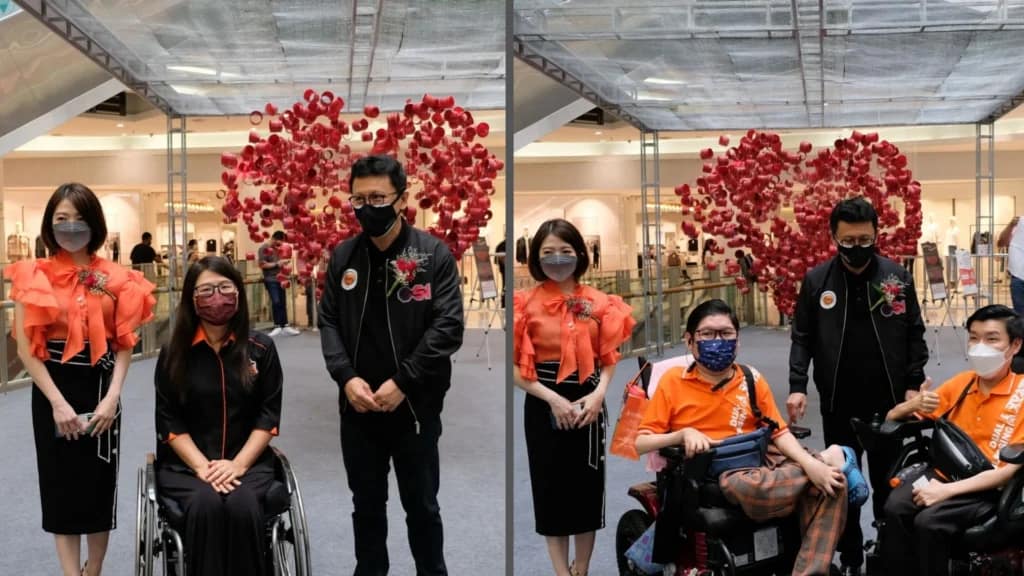
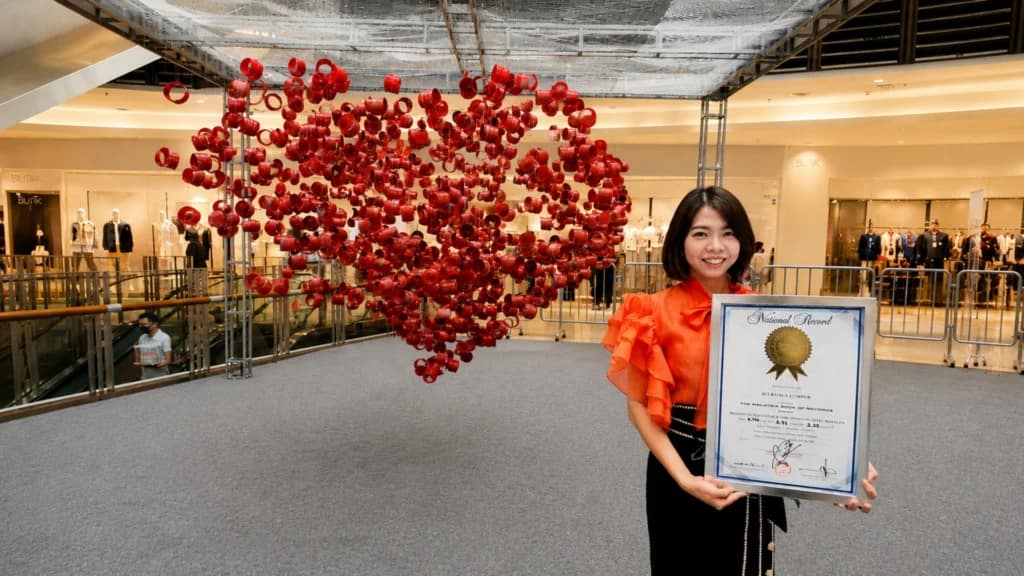
Stand to the side and the entire structure would shift. The words would dissolve. And in their place, a completely different image would emerge: a love heart formed by two hands holding each other — a symbol of community, care, and connection.
Two distinct perceptual images. One physical structure. Every bottle, every fishing line, every bead serving double duty — calibrated to resolve both views simultaneously from their respective angles.
This is, in the language of 3D perceptual art, extraordinarily difficult to calculate. And finding someone who could do it nearly broke the project before it started.
The Month I Spent Looking for One Person
I need to talk about the calculation problem, because it was the closest we came to the whole project simply not being possible.
To create a 3D perceptual art installation of this scale — with thousands of bottles suspended on fishing lines, each at a precise position in three-dimensional space — you need someone who can do the full mathematical calculation. Not just the visual concept. Not just a rough sketch. The actual coordinates of every single line, every bead spacer, every suspension point across the entire iron mesh framework.
I found my first candidate: a professional with an interior design background. He could work with 3D. He understood spatial form. But when it came to calculating the precise positions of thousands of fishing lines across a large-scale perceptual structure — he couldn’t get there. The calculation was beyond what his training had prepared him for.
My second candidate brought interior design and architecture together. Stronger foundation. More technical depth. He genuinely tried. But in the end, the same wall: the calculation for thousands of precisely positioned lines, engineered to resolve two separate perceptual images from two angles, was still out of reach.
I spent nearly a month searching. I reached out to professionals. I explained the project. I heard — more than once — that what I was describing was not realistic. That it couldn’t be done. That the idea was, frankly, crazy.
Then I found my third person.
His academic background combined interior design, architecture, and actuarial science — the mathematics of probability, precision, and complex calculation — all in a single degree. Three disciplines in one person. When I called him and explained what I needed, he didn’t say it was crazy. He said he would try.
One week later, he came back to me with the complete calculation.
Every single line. Every bottle position. Every spacing dimension across the entire structure — calculated for both views, front and side, simultaneously. The full document laid out before me, precise and complete, exactly what the two previous professionals had not been able to produce.
I was genuinely stunned. After a month of searching, after two dead ends, after hearing the word “impossible” more than once — here it was. The thing that would make the entire installation possible, delivered in a week by someone who simply had the right combination of knowledge to see a problem others couldn’t solve.
We had found the one.
The physical construction of the installation was a category of challenge unto itself.
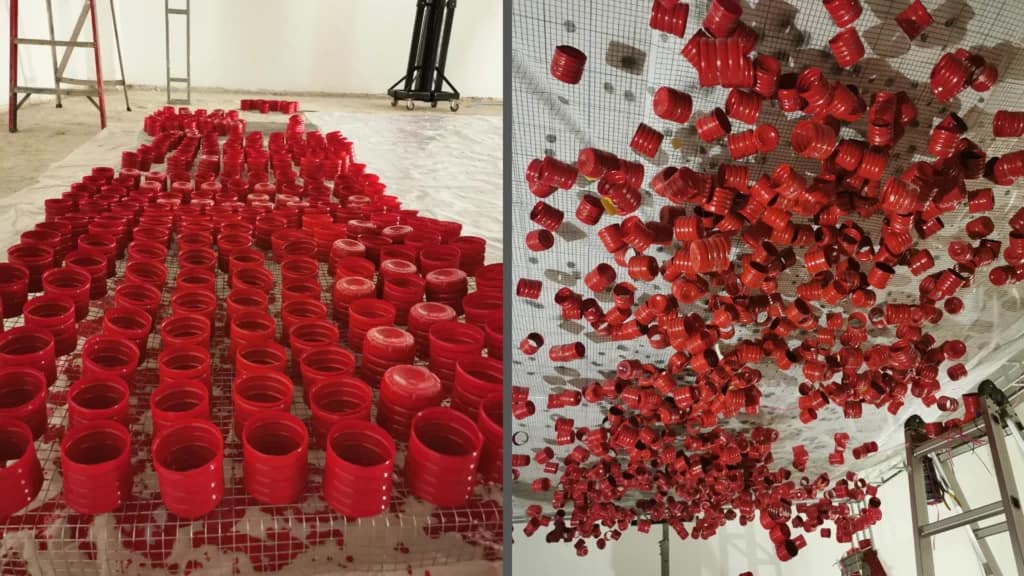
The medium we chose was recycled plastic bottles — chosen deliberately for their environmental symbolism and their visual properties under light. But before a single bottle could be threaded or hung, every single one of them had to be painted red.
That sounds simple. It was not.
We painted all the bottles inside the shoplot. The fumes from the paint filled the enclosed space quickly and heavily. We were all wearing masks — this was 2021, masks were already part of daily life — but in a sealed shoplot thick with paint fumes, a mask only does so much. There were moments when breathing was genuinely difficult. Everyone pushed through. No one left. The bottles got painted.
That is the kind of detail that doesn’t make it into press releases, but it is the kind of detail that tells you exactly what this team was made of.
Every bottle had to be positioned at a computer-calculated distance from the others. The spacing between each bottle was not guesswork; it was geometry. The illusion only works if every element is precisely where the mathematics says it should be.
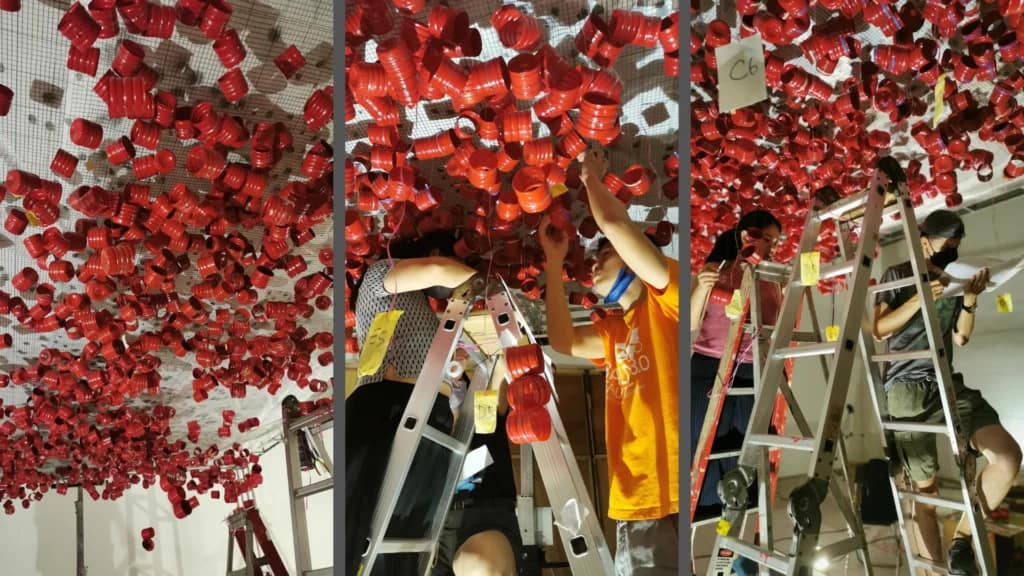
Between every bottle ran fishing line threaded with beads — each bead a spacer, holding the exact gap required to make the 3D image resolve correctly when viewed from the designated point. Thousands of fishing lines. Thousands of beads. Threaded by hand, checked, re-checked, and then climbed up ladders to be hung within the iron mesh frame that formed the installation’s structure.
If a line was wrong — if the spacing was off, if the angle didn’t resolve — it had to come down and be redone. From scratch. The process was repetitive, precise, and unforgiving.
And every single person doing this work had a full-time job. Our committee members worked their day jobs, then came to the mall at night. They were there until midnight. Some nights later. The age range — 23 to 80 — meant nothing in those hours. Everyone climbed ladders. Everyone threaded beads. Everyone showed up.
Spending a month of nights inside Paradigm Mall gave me a view of the place that almost no visitor ever sees.
After 10pm, the mall belongs to a completely different world. The shopfronts go dark, the music stops, and the corridors empty out — but the building does not sleep. Every night, renovation crews arrived. Contractors installed fixtures. Shop fittings were drilled in, walls were replastered, new outlets took shape in real time. The entire back-end lifecycle of a shopping mall — the construction, the maintenance, the becoming — happens in those hours, invisible to the daytime crowd.
Over the weeks, I got to know the security guards assigned to our section. We saw each other every night. They watched us thread bottles and climb ladders; we watched them do their rounds through a mall that felt, after midnight, like an entirely different building. There is a strange intimacy to that kind of routine — built not from conversation but from shared presence in a space that most people never get to inhabit.
It is one of those unexpected things this project gave me. A different way of seeing a place I had walked through a hundred times before.
The Moment Nobody Expected — Including Us
Three months of planning. Twenty-two days of physical construction. And then, at some point in those final days, the installation resolved.
I think about this often. For most of the build, the team was working from a flat plan — a 2D layout on paper showing positions, angles, measurements. That was what I showed everyone in the briefing at the start. A diagram. Lines and numbers and coordinates. Not a picture of what it would actually look like when it was done.
Nobody on the team had ever seen a project like this in real life. Neither had I.
So when the bottles finally hung in their correct positions, when you stepped back to the viewing point and the entire structure suddenly resolved — when the text appeared, when the love shape emerged from the side — it was a kind of shock. The quiet, physical shock of seeing something you had only ever imagined on a flat page become a real, three-dimensional presence in front of you.
After three months of exhaustion, of late nights and paint fumes and tangled fishing lines and COVID anxiety — that moment of seeing the finished result was enormous. I believe many of us, in that instant, finally understood what we had actually been building.
Finding Sponsors: 50/50, or Zero
Finding sponsors for Stay Strong, Spread the Love came with its own particular challenge: this was a first-time NGO campaign, with no fundraising track record to point to, no existing relationships with corporate CSR departments, and no warm introductions to open the door. What we had was an idea, a team, and a cause worth believing in.
When the anxiety of it started to creep in, a friend offered a line that cut through everything: “If you make the call, the chances are 50/50. If you don’t make the call, the chances are zero.”
The calls went out. Large corporations, established businesses, companies with no prior connection to the project. Some did not respond. Some said no. But some responded — and a few, remarkably, said yes almost immediately, agreeing to come on as main sponsors before we had even gone into detail.
The format was brutal and clarifying: most decision-makers would give me two minutes on the phone. Two minutes to make the case — what the project was, why it mattered, what their involvement would mean. If the two minutes landed, they would agree to a Zoom call to see the full proposal. If they came to the Zoom, they almost always came on board.
Two minutes sharpens a pitch. You learn very quickly what a project is really about — and what it isn’t.
It also helped that this was 2021. The pandemic had taken an enormous toll — on people, on businesses, on the collective sense of hope. Large corporations and SMEs alike were looking for ways to contribute to something larger than their balance sheets. There was a generosity in the air during that period — quiet, unprompted, real — and Stay Strong, Spread the Love caught it.
The most unexpected moment of all happened in a café.
I was sitting with a team member, going through project details, talking through logistics and plans. At some point, the person at the table next to us stood up, walked over, and said: “I’ve been listening to what you’ve been discussing. I want to do my part during COVID. Can I sponsor the VIP gifts for your event?”
A complete stranger. Someone who had no connection to me, to JCIKL, to the project. Someone who simply overheard a conversation in a café and decided to be part of something.
I said yes. He became a sponsor. And then he became a friend.
That moment — more than any formal pitch, any successful Zoom call, any signed agreement — reminded me what this campaign was actually about. People helping people, without needing to be asked twice.
COVID Was Not a Background Detail
I want to be direct about this, because it is easy to mention “COVID restrictions” as context and move on. But the pandemic was not background noise during this project. It was a constant, active challenge that shaped every decision we made.
Every day that team members came to the mall, they had to pass a fever screening. Masks were mandatory at all times — while working, while climbing, while threading lines in the middle of the night. Physical distancing requirements affected how many people could work in the same space simultaneously, which affected our pace and our planning.
And the most frightening scenario of all was this: if one person tested positive for COVID, the entire team would need to go into quarantine. That was not a hypothetical. It was a live threat throughout the entire build. We were obsessive about health monitoring. Not because of rules, but because one positive case could have ended the project entirely.
Somehow, we stayed healthy. Somehow, we stayed on schedule.
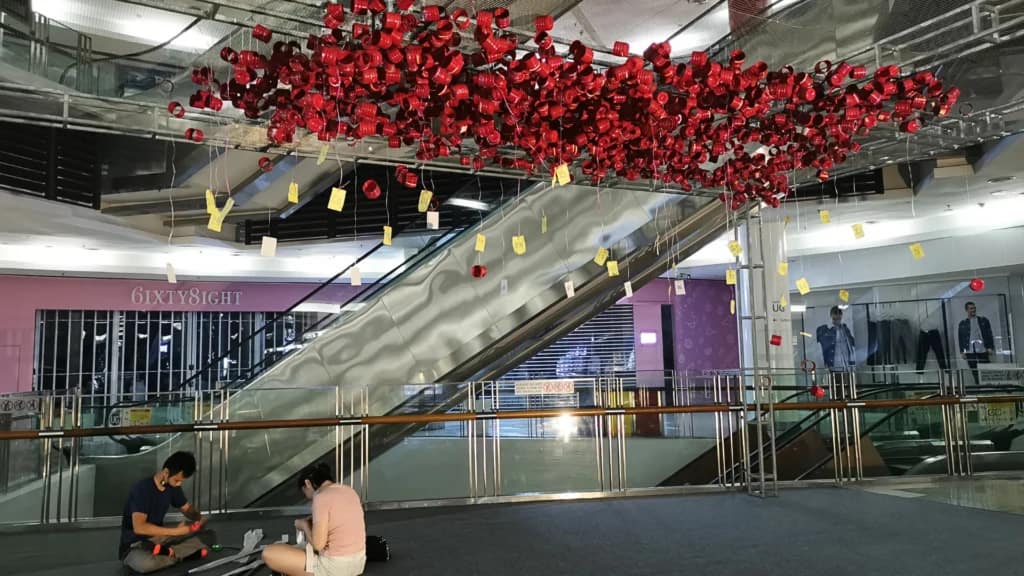
The Transfer That Nearly Undid Everything
When the installation was complete in the shoplot, we faced a challenge we had technically planned for — but nothing fully prepares you for the moment it happens.
The 3D installation had to be moved from the shoplot into Paradigm Mall’s centre court. The ceremony, the media, the VVIP guests — all of it was going to happen in the centre court. The shoplot was always a build space, not the final stage.
To make the transfer, the entire iron mesh structure had to be dismantled and moved through the mall’s service routes, into an elevator, and reassembled in the centre court. It is a process that sounds manageable until you are watching it happen.
When the installation came through that elevator and the structure shifted — thousands of bottles, thousands of fishing lines, the entire architecture of the piece — everything tangled. Everything fell. The installation that had taken weeks to build came apart in the transition.
We had three days to fix it. And we could only work in the centre court between 10pm and 6am, after the mall had closed to the public.
Friday night. Saturday night. Sunday night. By the end of Sunday, it was done.
I do not have the words to fully describe what that team showed in those three nights. Exhausted, working through the small hours of the morning, reconstructing a record-breaking installation by hand, in a shopping mall, during a pandemic. Every single person who showed up in that centre court on those three nights — you carry a part of this record with you.
The Record
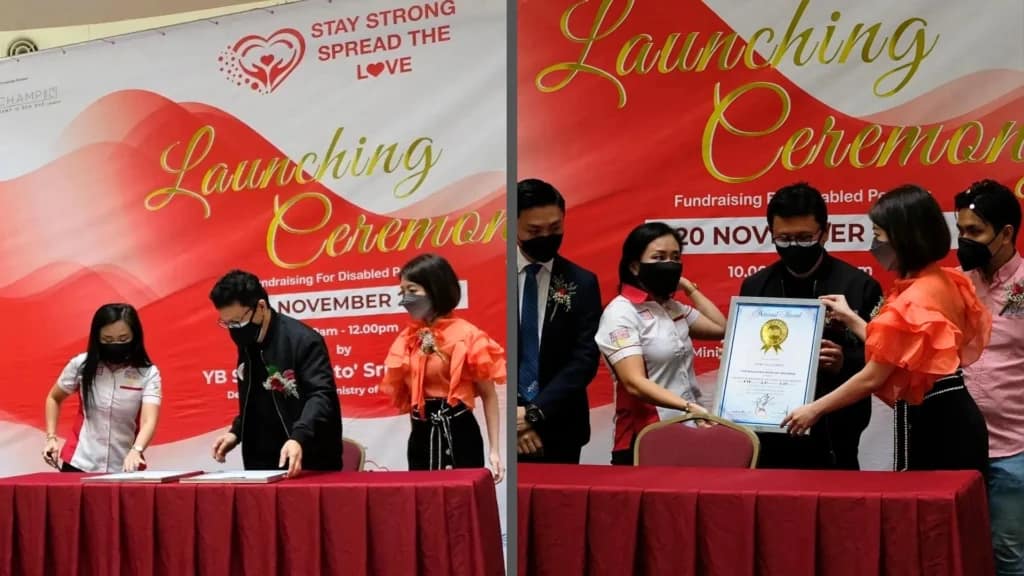
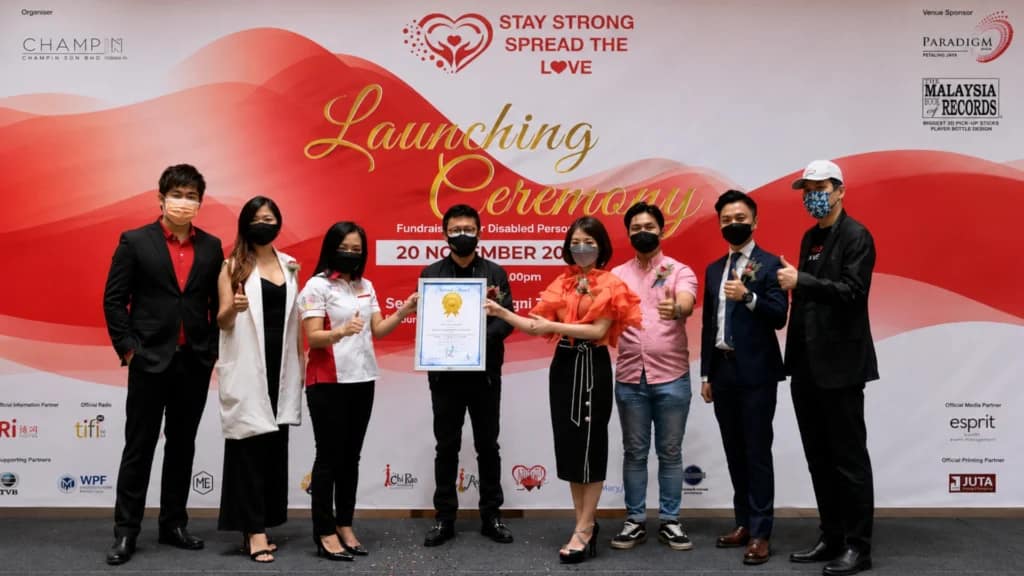
On the day of the official ceremony, YB Senator Dato’ Sri Ti Lian Ker officiated the launch. Ministers, VVIPs, sponsors, media, and visitors filled the space. The cameras were there. The moment was real.
Stay Strong, Spread the Love was officially recognised by the Malaysia Book of Records as Malaysia’s Biggest 3D Perceptual Art Installation Using Plastic Bottles.
It was Malaysia’s first. It was JCIKL’s largest project. And for many of us — including me — it was the hardest and most meaningful thing we had ever done.
The funds raised went to OKU communities. The media coverage reached audiences across Malaysia. The message — Stay Strong, Spread the Love — did exactly what it was meant to do.
https://www.youtube.com/watch?v=e0HWtsFbzLA
A Note of Gratitude
This project was never mine alone.
To every member of JCIKL who said yes before there was anything to show — thank you. To the committee members aged 23 to 80 who climbed ladders at midnight and came back the next night — thank you. To Paradigm Mall for giving us the space and the trust — thank you. To our sponsors, media partners, and donors — thank you. To Infinite Loop Media for the documentation and support — thank you.
And to everyone who came to see the installation, who stopped and looked, and who felt — even briefly — that things were going to be okay.
That was the whole point.
About the Author
Serah Siew (萧思玉) is an Asia-based Creative Director, Branding Consultant, and Contemporary Artist. She is the Organising Chairman of Stay Strong, Spread the Love, Founder of Tiny Art Gala. Her work spans cultural exhibitions, diplomatic event branding, corporate identity, and large-scale public art across Malaysia, Singapore, and Asia.
🔗 serahsiew.com 📸 @serahsiew on Instagram
© Serah Siew. All rights reserved.