By serahsiew May 14, 2026 2:34 PM
How to Organise an International Art Exhibition: A Creative Director’s Guide
EXHIBITION ORGANISING · CREATIVE DIRECTION · CULTURAL EVENTS
It started with a question I could not stop asking: why do so many talented people never get their first exhibition? One year, fifteen volunteers, 2,150 artworks, and a national record later — here is everything I learned.
By Serah Siew / 萧思玉
Creative Director & Exhibition Organiser · Founder, Tiny Art Gala
I have seen a grown adult jump — arms up, voice breaking — because a stranger paid RM100 for something they made with their own hands. I have watched a group of autistic children stand quietly in front of their sold artwork, unable to find the words, but smiling in a way that needed none. I have seen elderly artists in their seventies and eighties stand in front of a 10cm × 10cm canvas they painted with the same precision they brought to their professional careers — and experience, for the first time in their lives, the feeling of a public audience saying: I see your work. I want to keep it.
That is why I spent a full year building Tiny Art Gala. Not for the record. Not for the media coverage. For those moments.
But this article is not just a story. It is a framework — for any organisation, brand, government body, or cultural institution in Asia that wants to create an international-scale art exhibition that actually means something. Because the logistics matter. The partnerships matter. The branding matters. And so does understanding, from the very beginning, what you are really trying to do and for whom.
71 : ARTISTS FROM ACROSS THE GLOBE
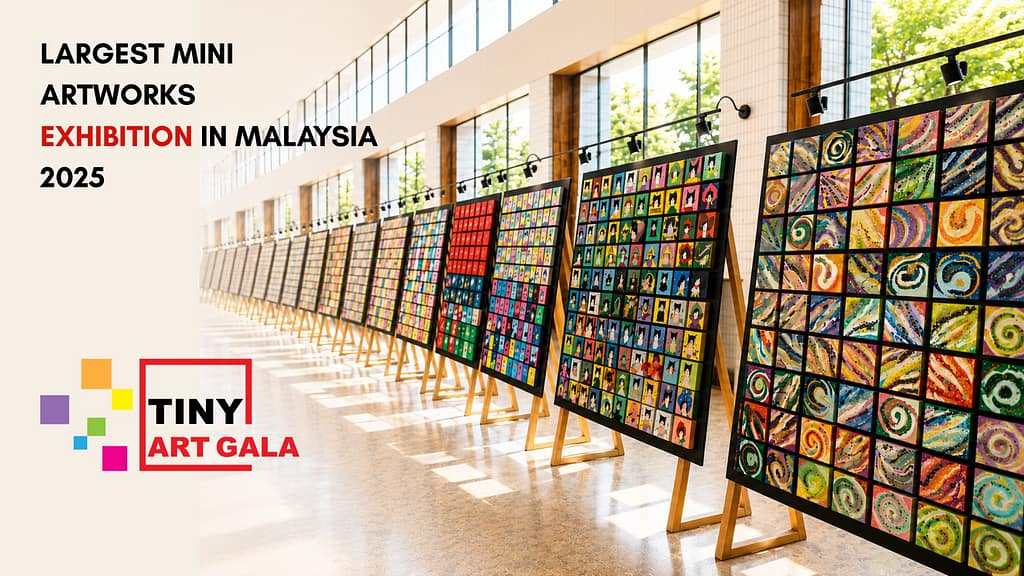
2,150 : ARTWORKS, EACH 10CM × 10CM
12+ : COUNTRIES REPRESENTED BY DIPLOMATS
Start with a problem worth solving — not a venue worth booking
The traditional art world has a closed-door problem. To exhibit, you need a reputation. To build a reputation, you need to have exhibited. For most people who paint — hobbyists, emerging artists, those who have created quietly for decades — the door simply never opens.
I kept meeting these people. A retiree who had been painting every week for fifteen years and never shown a single piece publicly. A young artist who submitted to galleries and heard nothing back. People with real talent, real voice, real work — locked out by a system that rewards the already-recognised.
The concept for Tiny Art Gala was built around one rule: every artwork would be exactly 10cm × 10cm, priced at RM100. The format was the equaliser. It removed hierarchy. A first-time artist and a seasoned creator stood side by side, in the same frame, at the same price. The work had to speak entirely for itself.
That single constraint shaped everything — the branding, the layout, the purchasing system, the media story, and ultimately the record-breaking scale. One clear concept, built around a real human problem, creates a chain of decisions that all point in the same direction.
THE FRAMEWORK PRINCIPLE
Before you book a venue or invite a single artist, write one sentence that names the problem your exhibition solves and for whom. That sentence becomes your creative brief, your sponsorship pitch, and your press release headline — simultaneously.
Who walks through the door — and why it matters
Tiny Art Gala attracted artists from 18 to 79 years old. Most were exhibiting for the first time in their lives. Understanding who they were — and what this experience meant to them — changed how we designed everything from the purchasing system to the wall layout.
THE FIRST-TIME SELLER
One artist — I will not name her because the moment was private — watched as someone lifted her piece from the wall and carried it to the counter. She did not say anything for a few seconds. Then she jumped. Arms up. A sound she could not quite control. It was the first time in her life that a stranger had chosen something she made, wanted to own it, paid money to keep it.
That is not something you can manufacture. But you can design an exhibition that makes it possible.
THE AUTISTIC ARTISTS
A group of autistic children participated in Tiny Art Gala. Their work was extraordinary — detailed, emotional, full of a perspective the world rarely gets to see on display. They hoped, through their art, that the world might understand something of how they experience it.
When their pieces were purchased, they did not know how to express what they felt. But you could see it — a real smile, the kind that arrives before language does. They stood looking at the wall where their work had been. Then at the person who had taken it. Then at each other. No words. Pure.
THE ELDERLY ARTISTS FROM THE CARE HOME
A group of elderly residents from a care home participated. They attended weekly painting classes — some had even studied under master painters. Each of them was a person who had spent a lifetime working in a professional field, now retired. Their paintings were realist, precise — human figures, scenes, still life — rendered with startling clarity inside a 10cm × 10cm canvas.
For many of them, this was their first ever public exhibition. It was also, for some, one of the most seen their work had ever been.
The range of participants — from autistic children to retirees, from hobbyists to serious practitioners — was not incidental. It was the proof of the concept. When you build an exhibition for access rather than prestige, the people who show up carry the most powerful stories.
Design the purchasing experience as carefully as the walls
Traditional art exhibitions use a red dot system — when a piece sells, a sticker goes on the wall beside it. For established artists with loyal collectors, this works. For a first-time exhibitor, it can be quietly devastating to stand beside your work while the wall next to you fills with red dots and yours stays bare.
At Tiny Art Gala, we removed the red dot entirely.
When someone wanted to purchase a piece, they took it directly from the wall to the counter. The artwork left the space. No public score-keeping. No visible hierarchy of success. What remained was the experience of the work itself — and the private thrill of watching something you made disappear into someone’s life because they wanted it there.
“Your first exhibition is not about selling everything. It is about the moment you discover your work exists in someone else’s world.”
This also introduced a psychological dynamic that we did not fully anticipate — and that turned out to be one of the most powerful aspects of the event. When you see the artist beside you having their pieces taken from the wall one by one, you feel it. There is a natural human response: why not mine? That feeling — uncomfortable, honest, real — is exactly what an artist needs to experience. It is the market speaking. And learning to hear it, to sit with it, to call your friends and family and build your own audience — that is the real lesson of a first exhibition. We designed the space to surface that lesson without cruelty.
The visual identity and the exhibition are the same decision
Most exhibition organisers treat branding as the final layer — the poster, the backdrop, the social media graphics, applied after the real decisions have been made. I work the opposite way.
As a creative director, the visual identity system and the curatorial concept must be developed simultaneously, from the same brief. They are the same decision expressed in two languages. When they are built separately, the exhibition feels assembled. When they are built together, it feels like a world.
For Tiny Art Gala: the mascot design drew from multicultural Asian costume traditions, representing the diversity of both the artists and the audience. The colour system balanced contemporary energy with cultural grounding. The installation design created a visitor flow that told a story from entrance to exit. The stage backdrop, the printed catalogue, the merchandise, the wall labels, the invitation — every touchpoint was part of one coherent system.
When someone walked in, they did not just see art on walls. They entered something that had been thought about. That feeling is what makes people photograph it, share it, and remember it.
THE FRAMEWORK PRINCIPLE
Engage your creative director at the concept stage — not after the venue is booked and the artists are invited. The branding is not a finishing layer. It is the structure that everything else is built on.
What nobody tells you: the year before opening night
We postponed Tiny Art Gala twice.
Not because of the artists. Not because of the venue. We postponed because we were waiting — for weeks, stretching into months — for confirmation from government officials on whether they would attend. Every week I would visit the office. Follow up. Wait. Visit again. The confirmation letter that had to come before anything else could be locked.
People ask how long government confirmation takes for an event of this scale. The honest answer: plan for six months to one year. We received our confirmation letter after ten months of waiting. Ten months of uncertainty, holding an entire structure — sponsors, partners, artists, volunteers, diplomatic offices, NGO — together on a promise that the final piece was still in motion.
WHAT TEN MONTHS OF WAITING ACTUALLY FEELS LIKE
You are the Organising Chairman. Every collaborating association, every sponsor, every government contact, every artist who has registered, every volunteer who has committed their weekends — they all come to you. And every one of them, in their own way, is asking the same question: Is this happening?
You cannot say no. You cannot say yes with full certainty. You say: we are on track, we are following up, stay with us. And then you go back to the government office. Again. You sit across the desk. Again. You send the follow-up email. Again. You carry the weight of every person who has staked something on this event — and you do not let them see how much the uncertainty costs you.
The confirmation letter arrived at month ten. I will not pretend I was calm when I read it.
This is where most first-time organisers at this scale do not understand what they have walked into. Why does government attendance matter so much? Because Tiny Art Gala was not a commercial gallery show. It was a charity exhibition — combining an NGO official partner (World Vision), volunteer teams, listed companies and SMEs as sponsors, and diplomatic missions from multiple countries. When you bring together that many institutions, government support is not optional. It is the structural anchor that makes everything else credible.
THE SPONSORSHIP REALITY
When approaching listed companies for sponsorship, the first question was almost always the same: “Which Minister will be attending?”
If you could not answer that question with certainty, the conversation effectively ended. Listed companies at an international event level need to know the calibre of official presence before they will commit their brand. No minister confirmation, no sponsorship. No sponsorship, no event. The circular dependency is real — and it is the most important thing to understand before you begin. Secure the government anchor first. Every other door opens from there.
Sponsors in Asia — and particularly in Malaysia — default to fashion shows, product launches, sports events. The return is legible. An art exhibition is a harder pitch. They imagine something small and quiet. They cannot see where their logo goes, who photographs it, what the audience looks like.
We solved this by making the invisible visible. We built full sponsorship decks with projected attendance figures, diplomatic guest profiles, NGO credentials, government endorsement, and a complete visual breakdown of exactly what every touchpoint would look like — the stage backdrop, the printed catalogue, the mascot merchandise, the media coverage format. We showed them the event before it existed. By the time sponsors committed, they were not sponsoring an art exhibition. They were sponsoring a record-breaking international cultural event with a minister in attendance and ambassadors from twelve nations.
“Sponsors do not give money to good ideas. They give money to evidence that the idea will happen, will look right, and will reflect well on them.”
As Organising Chairman, I was the single point of contact for every stakeholder simultaneously — the collaborating associations, the sponsors, the government contacts, the artists, the volunteers, the NGO partner, the diplomatic offices. Every question, every delay, every complication arrived at one person. There were moments — more than I would like to admit — of genuine doubt about whether it would all come together. Ding dong, ding dong, back and forth, week after week. Holding the structure intact while the most critical piece was still unconfirmed.
But the committee held. The volunteers held. The artists who had trusted us with their first-ever exhibition held. And ten months in, so did the government.
But the final event happened. Every committee member, every volunteer, every artist who trusted the process — they made it real. And standing in that exhibition space on opening night, watching a minister take his seat beside ambassadors, watching an autistic child smile at a stranger holding their artwork, watching an elderly woman see her painting lifted from the wall — that is worth everything the year cost.
THE MOST IMPORTANT LESSON
Before planning anything else for an international-scale exhibition, secure two things first: the venue and the government support. Not simultaneously — sequentially. Government first, then venue, then everything else. Without those anchors confirmed, every other element of your planning is provisional. This sequence is the one thing I wish I had known before I started.
The planning framework: what 12 months actually looks like
Month 1–2 : Concept finalised. Core team formed. Government outreach begins immediately — this is not a later step. Do not delay it for a single week.
Month 3–4 : Visual identity development begins alongside concept. NGO partner approach. Sponsorship deck built with full design system. Artist open call launched.
Month 5–7 : Artist confirmations. Sponsor negotiations with government attendance as confirmed anchor. Diplomatic outreach through formal channels. Mascot and key visual completed.
Month 8–10 : All materials in production — collateral, merchandise, stage design, installation plan. Media outreach begins. Press materials prepared with photograph-ready moments designed in.
Month 11 : Final rehearsal. Artwork collection and cataloguing. Volunteer briefings. All confirmations — government, diplomatic, NGO — in writing.
Opening day
Ministers. Ambassadors from 12+ countries. Distinguished guests. 600 visitors over two days. 2,150 artworks. Malaysia Book of Records. First-time sellers. Elderly artists. Children who could not find the words. It looks effortless because the year was not.
What makes an exhibition truly international
It is not the passport of the artists. It is not the location.
An exhibition becomes international when the concept is universal enough to matter beyond one culture, the visual identity is sophisticated enough to travel, the partner structure includes institutional credibility, and the documentation is strong enough to be shared across borders in multiple languages.
Tiny Art Gala was held in Kuala Lumpur. The artists came from across the globe. The diplomats represented over twelve nations. The coverage appeared in English, Malay, and Chinese-language media. The Malaysia Book of Records certification gave it a permanent, internationally citable credential.
The geography was Malaysia. The ambition — and the reach — was global.
Most regional exhibitions never cross this line because they are designed for a local audience and framed as a local achievement. An international exhibition is designed for a universal concept and happens to take place somewhere specific. That difference lives in the brief — and in how the concept, the visual identity, the partnerships, and the media strategy are built together from day one.
Handmade Peranakan pineapple tarts by Yin’s Nyonya Bites — one of Malaysia’s top-ranked pineapple tart brands — were served to VIP guests at the opening, adding a layer of Malaysian hospitality to the cultural occasion.
Website : https://tinyartgala.com/
Questions about organising an international art exhibition
How long does it take to organise an international art exhibition?
For a large-scale international exhibition with diplomatic guests, NGO partners, and corporate sponsors, plan for a minimum of 12 months. The longest lead times are government confirmation and diplomatic invitations — neither can be rushed. A smaller curated group exhibition can be executed in 4–6 months, but anything involving institutional partnerships and official presence requires a full year minimum.
What is the difference between an exhibition organiser and an art curator?
An exhibition organiser manages logistics — venue, timeline, budget, sponsors, volunteers, media coordination, and stakeholder communication. An art curator makes the creative decisions — which artists are selected, what narrative connects the works, how the visitor experiences the space. At Tiny Art Gala, I held both roles, which meant the branding, the curation, and the event structure were built as one unified system rather than separate layers added at the end.
How do I get government support for an art exhibition in Malaysia?
In person, consistently, and early. Government offices in Malaysia and across Asia respond to persistence and proper process — not emails alone. Visit the relevant offices. Bring documentation. Follow up weekly. Understand that the confirmation may take months, and build that wait into your timeline from the beginning. Do not plan anything contingent on government attendance until the confirmation letter is in your hands.
How do I attract corporate sponsors for an art exhibition?
Make the invisible visible before the event happens. Build a sponsorship deck that shows sponsors exactly what their brand association looks like — the backdrop, the printed materials, the media format, the guest profile, the official presence. Sponsors in Asia respond to credibility markers: ministerial attendance, NGO partnership, diplomatic presence, and a record-level credential. Never ask a sponsor to imagine. Show them the event as it will look, before it exists.
Do I need separate teams for the branding and the event organisation?
Most exhibitions treat them as separate workstreams, and the result is a branding system that feels applied rather than integrated. The strongest exhibitions are built when creative direction and organisational structure develop together from the same brief. If you can work with someone who holds both disciplines, the exhibition will feel like a world rather than a collection of things in a room.
How do I make an art exhibition inclusive — for emerging artists, elderly participants, or special needs groups?
Start with the concept. The 10cm × 10cm format at RM100 was not an aesthetic decision — it was an access decision. It removed every barrier that normally excludes first-time exhibitors: no portfolio requirement, no gallery reputation needed, no prohibitive price point for buyers. The format creates the inclusion; the rest of the system supports it. Design the constraint first, then build the exhibition around it.